

 8 mins Read
  23/06/2026
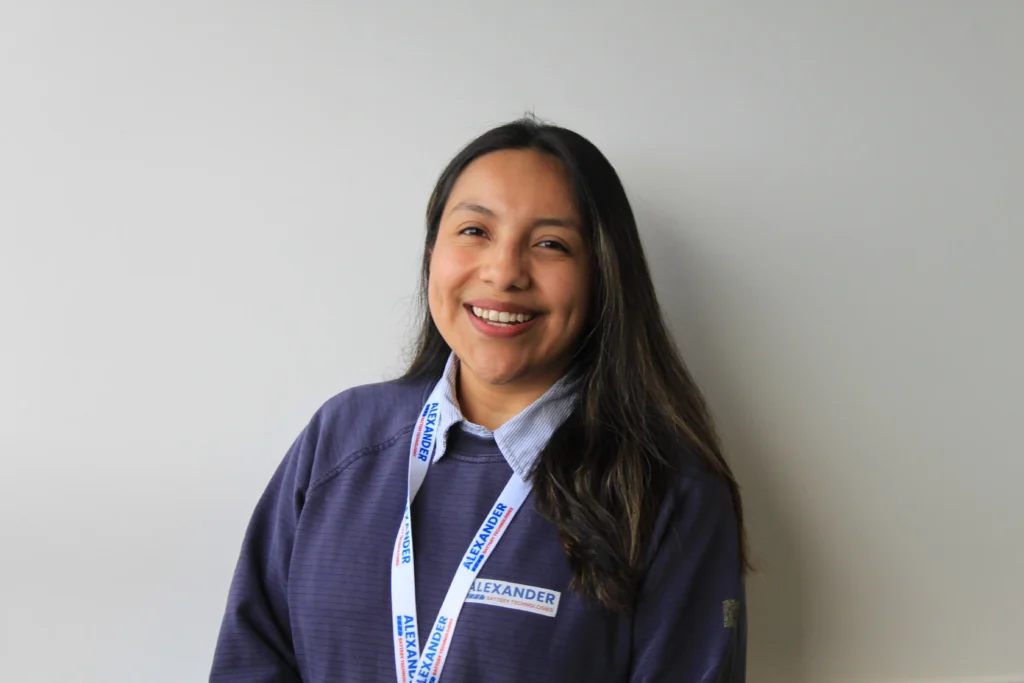
 As part of International Women in Engineering Day (INWED), we spoke with Diana Sanchez, our Project Manager, about engineering intelligence, adaptability, innovation, and why curiosity remains one of the most valuable qualities in the industry.
Diana has been with Alexander Battery Technologies for two and a half years. She holds a bachelor’s degree in industrial engineering from Monterrey Institute of Technology and Higher Education, and proudly, a master’s in engineering management from Cranfield University and was one of just five Latin American women awarded a Women in STEM scholarship that enabled her to study in the UK.
This year’s INWED theme is #EngineeringIntelligence. What does engineering intelligence mean to you in your role as a Project Manager?
“Engineering intelligence for me is more than the technical intelligence, I think its more about being adaptable, being convertible and the teamwork. It also involves being highly creative, it might not seem like engineering is the most creative job, but it does involve problem solving and you need to be creative in how you solve those problems. So, I think that fits in well with engineering intelligence, taking a problem, working towards a solution and being able to communicate it across multiple teams and pass that message onto the customer is a skill that is vital in engineering.”
Your career has taken you through different engineering sectors. How have those experiences shaped the way you approach problem-solving today?
“I got a bachelor’s degree in industrial engineering, so I always knew I wanted to do something with problem solving. I am very analytical but also highly creative so I thought this was an exceptionally good mix for me.
The first job I ever had was at an industrial factory, it was a great to see what I have learned in school is happening in real life. However, it was then I saw that not everything goes to plan and problems can occur no matter the planning or preparation. Ever since then I’ve worked in industrial environments starting in finance and working my way round to project management and engineering. From working within multiple industries such as oil and gas, pharmaceuticals and now battery manufacturing. It has been quite a challenge, but I have learned a lot and gained transferrable skills from industry to industry to make me more of a well-rounded engineer. It is then when I realised that engineering is very heavily about being adaptable and the teamwork. That is how I learned to build my confidence working in a male dominated environment, as you have to be confident to talk in a room where you are one of the only women in there.”
Can you share an example of a project where innovation or creative thinking helped overcome a significant challenge?
“We did have a customer where the requirements kept changing throughout the design process., This created a lot of back and forth between our team and the customer, and, the project was at risk of being delayed.
Rather than continuing with the same approach, we changed the way we worked with the customer. The team and I then turned the customers questions on their head; we asked them to map out exactly what they wanted the battery pack to achieve. From here, we were able to consult with them more clearly on what was technically possible and what where compromises might be needed.
Not only did this mean less back and forth, but it gave both teams a clearer shared understanding of the final design. It also strengthened the relationship with the customer, because the process became more collaborative rather than transactional. As a result, we were able to move the project forward more efficiently while building a stronger partnership with the customer.”
Battery technology is evolving rapidly. What developments in the industry are you most excited about, and why?
“I am excited to see how AI will make an impact on the battery industry. AI is becoming like the new best thing, alongside sustainability, and I think both will play a major role in how battery technology continues to evolve.
I’m excited by digital transformation and how industries are changing so quickly as a result of these innovations. In my team, for example, we are going to have to be adaptable and ethical with the introduction of AI, making sure we use it in a way that support better decision-making and improves how we work, without losing the value of our existing knowledge and collaborative approach to working with customers.
With future hires, I think we will increasingly see people coming into the industry with stronger AI and digital skills. So, we will be merging our previous experience and ‘traditional’ skillset with a new futureproofed skill set that can support the next stage of battery development.”
As someone who works across multiple teams and disciplines, how do you ensure everyone stays aligned towards a common goal?
“One method is our IFS ERP system. Everything is logged and traced back onto it. From customer orders to material delivery information, technical change requests, quality stats, and manufacturing data; the system provides business-wide visibility at every stage of a customer’s project.
Also, having an open channel of communication across all projects. If there are any issues, they don’t wait until a scheduled meeting, it will be raised immediately. I am a huge believer in open communication with the team, even if it’s a lot going on, I would rather know about it and be aware of it than have no idea till after the fact.”
What advice would you give to young women who are considering a career in engineering but may not yet see themselves in the industry?
“Times are changing and the misconception is starting to disappear that engineering is purely for the ‘boys’ or that it’s boring. Engineering for me is creativity and solving problems. The advice I would give would be, if you’re driven by curiosity and you really like finding solutions to challenges, look into engineering. Even if you doubt yourself or think ‘that might not be for me, it sounds too complicated, too difficult,’ believe me, if in your core you have that curiosity that will take you far. Just ask questions, ask tonnes of questions.
Also having someone relatable in these spaces makes such a significant difference. Therefore, having days like International Women in Engineering Day gives the next generation of female engineers the ability to see that it is possible for women to thrive in these environments. Representation matters! I remember when I was a teenager, I was about to pick a career and I think I saw a movie with friends and engineers were a core part of the film working on a space project and for me that was like ‘wow okay, hang on this is something I could do’ prior to this I’d never thought about engineering, it looked really cool and from there I just started investigating engineering. I started Googling important engineers throughout the world and a ton of other questions. This is when I found there isn’t just one type of engineer, its so diverse and that opened the door for me. Just don’t underestimate your perspective because diversity is what’s driving innovation.”
What unique strengths do you believe women bring to engineering teams, and how do those strengths contribute to innovation and success?
“I do believe, women are better communicators and that is super valuable when working in an engineering environment. Especially when it becomes fast paced, keeping the teams and customer up to date needs to be thick and fast.
In engineering you will also work with different people with different backgrounds. So what you bring to the table is a huge advantage to any team. I also feel due to the diversity and introduction of women in engineering we can be naturally more curious and quizzical. Which in turn may result in different working patterns or fixes to ‘unfixable’ problems.
Something that is also quite common, is imposter syndrome for women in STEM. I’ve surely had it when you work with so many brilliant minds and incredible businesses, it’s easy to question yourself. But what I’ve learned so far is that growth comes from putting yourself in challenging environments genuinely helps build your confidence. I have learned so much from putting myself in a responsible decision-making role.”
Thank you Diana for taking the time to talk to us. And happy International Women In Engineering Day to all the amazing female engineers!